M1 Igaki Asahi Wins 2026 Architectural Institute of JAPAN Award for Laos Coffee Farming Life and Living Space Study
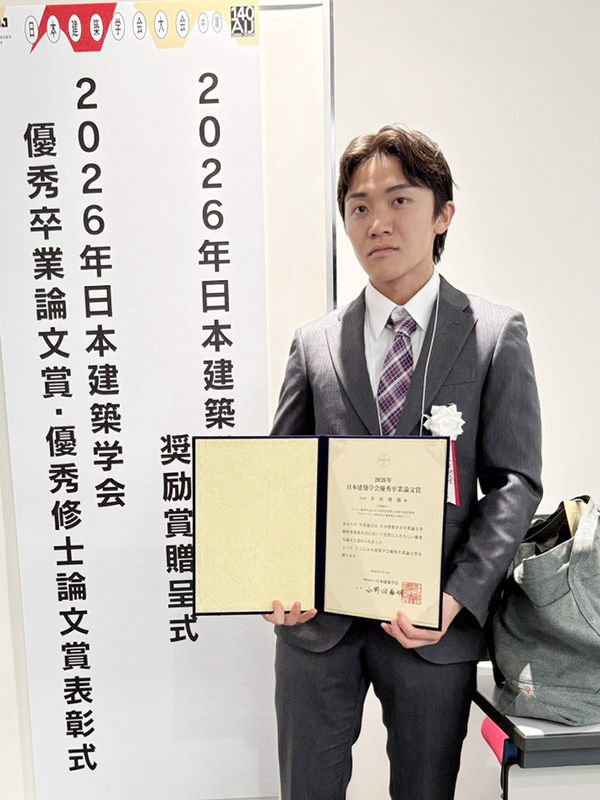
A strong architecture thesis does more than describe buildings. It reveals how people live, work, adapt, and sustain community through space. That is the power of M1 Igaki Asahi’s award-winning research, 「コーヒー農耕社会における居住空間と生業の相互関係」, which received the 2026 日本建築学会優秀卒業論文賞.
The study focuses on coffee-producing regions in Laos, where homes are not simply places of rest. They are tied closely to farming, processing, storage, family care, seasonal labor, and local exchange. By looking at the relationship between living spaces and livelihoods, Igaki’s thesis brings attention to a vital question in architecture: how can built environments support the real rhythms of daily life?
That question matters far beyond one region. In many rural communities, architecture is not separated from work, kinship, land, and local economies. Igaki’s research shows why careful field-based study can help architects understand those connections with greater detail and respect.

The award recognizes research grounded in everyday life
The 2026 日本建築学会優秀卒業論文賞 honors outstanding graduation research in architecture. Igaki’s achievement stands out because his thesis looks closely at ordinary spaces that are often overlooked.
The title, 「コーヒー農耕社会における居住空間と生業の相互関係」, can be understood as a study of the mutual relationship between residential space and livelihood in a coffee farming society. The focus is not only on what houses look like. It is also on how they function across different tasks, seasons, and family arrangements.
This framing gives the research its depth. A house in a coffee-producing community may support many roles at once:
A place for sleeping, cooking, and gathering
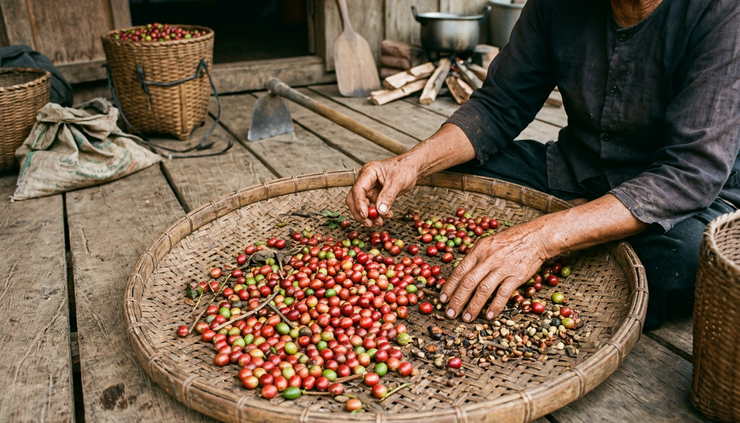
A site for sorting or drying coffee
A storage area for crops, tools, and household goods
A base for family labor and neighborhood cooperation
A social space where information and support circulate
By studying these overlapping uses, Igaki’s work connects architectural space with social and economic life. That connection is especially valuable in rural regions where household survival depends on flexibility.
Living and working spaces are closely integrated
One of the key findings of the thesis is the flexible integration of living and working spaces. In Laos’ coffee-producing regions, domestic space and agricultural work are not arranged as separate worlds. They often share the same courtyards, semi-outdoor areas, verandas, storage zones, and pathways.
This flexibility is practical. Coffee farming involves stages that change throughout the year. Harvesting, drying, sorting, storing, and transporting each require different spaces and labor patterns. A household may need open ground or raised platforms during one period, covered storage during another, and shared gathering areas at still another point in the farming cycle.
Architecture responds to these needs through adaptable use rather than fixed programming. A veranda may become a sorting area. A yard may become a drying space. A room may hold both domestic items and farming equipment. These arrangements show how residents use space with skill and care, adjusting the home to meet changing demands.
For architects, this is an important lesson. Rural housing should not be evaluated only by formal plans or standard room categories. The real meaning of a space often appears through use.

Family networks sustain both labor and community
Igaki’s thesis also highlights the role of familial networks in sustaining livelihoods. Coffee farming depends on labor, timing, and trust. Family relationships help organize these needs in ways that formal systems may not fully capture.
In many agricultural communities, work is shared among relatives across households. People may help with harvesting, processing, childcare, food preparation, transport, or maintenance. These exchanges can be shaped by age, household size, economic need, and seasonal pressure.
The home becomes a key setting for this support. It hosts visiting relatives, shared meals, temporary work groups, and everyday conversation. In that sense, residential space supports more than shelter. It supports the social relationships that keep livelihoods going.
This finding adds an important layer to architectural research. If a house is studied only as an isolated unit, much of its meaning is lost. Igaki’s work shows that residential space should be understood as part of a broader network of people and labor.
The value of the thesis lies in its attention to how space, work, and family ties operate together in daily life.
That insight can help future studies of rural architecture avoid overly simple categories. A household is not only a building, and a livelihood is not only an occupation. Both are shaped by relationships that unfold in space.
Why the Laos coffee region matters for architectural study
Coffee-producing regions in Laos provide a meaningful context for this research because they combine agricultural production, household-based work, local exchange, and changing economic pressures. Coffee is both a crop and a social force. It influences land use, daily schedules, family labor, and the ways homes are adapted over time.
This makes the region especially important for understanding how architecture responds to livelihood. The built environment is not static. It changes with farming cycles, family composition, and market conditions.
Igaki’s study also contributes to a wider discussion about sustainability. In rural communities, sustainability cannot be reduced to materials or energy performance alone. It also involves whether homes can support work, care, income, and social cooperation without weakening local life.
That point gives the research practical value. If future housing, tourism, or regional planning projects ignore the links between dwelling and livelihood, they may create spaces that look improved but function poorly. By contrast, planning that respects existing spatial practices can support communities more effectively.
Future research can follow family ties and labor exchange
The next stage of this research can build on one of its strongest themes: the relationship between family structure and work. Continuous investigation of family relationships and labor exchanges would help clarify how households respond to change.
Several questions appear especially useful:
How do relatives share labor during peak coffee seasons?
How do age and household size affect the use of space?
How do migration, education, or outside employment change family work patterns?
How are homes adapted when coffee production grows or declines?
How do informal exchanges support households during difficult periods?
These questions matter because rural space is shaped over time. A single survey can capture one moment, but long-term observation can show how homes and livelihoods adjust across seasons and generations.
Future research could also compare households with different economic conditions or different levels of involvement in coffee production. Such work would deepen understanding of how architecture supports resilience in rural communities.
Local tourism may support sustainability if it respects daily life
Igaki’s thesis also opens a path toward practical strategies for sustainability through local tourism. Coffee-producing areas often attract interest from visitors who want to learn about farming, food culture, and rural landscapes. If handled carefully, tourism can create additional income while reinforcing local identity.
The risk is that tourism can also distort daily life. Homes and workspaces may be staged for visitors, or local routines may be reshaped around outside expectations. Sustainable tourism should avoid turning community life into a display.
A better approach would build from the spatial relationships already identified in the thesis. For example, small-scale tours could explain coffee drying areas, household work zones, and family-based production systems without disrupting them. Local guides could help visitors understand how architecture supports farming life. Community-led lodging or learning programs could spread benefits across households.
The goal should be to support, not replace, existing livelihoods. Research like Igaki’s can help planners and communities decide what kinds of tourism fit local space, labor, and family networks.
A thoughtful contribution to architecture and rural sustainability
M1 Igaki Asahi’s recognition by the 2026 日本建築学会優秀卒業論文賞 is a notable achievement, but the deeper value lies in what the thesis helps us see. 「コーヒー農耕社会における居住空間と生業の相互関係」 shows that homes in Laos’ coffee-producing regions are active, flexible, and socially connected spaces.
They support farming work, family cooperation, storage, processing, rest, and exchange. They change with seasons and needs. They reveal how architecture can sustain everyday life when it grows from the practices of the people who use it.
The takeaway is clear: studying rural living spaces requires attention to labor, kinship, and local economies. Igaki’s work offers a strong model for that kind of research, and it points toward future studies that can support both architectural knowledge and community-based sustainability.

Comments